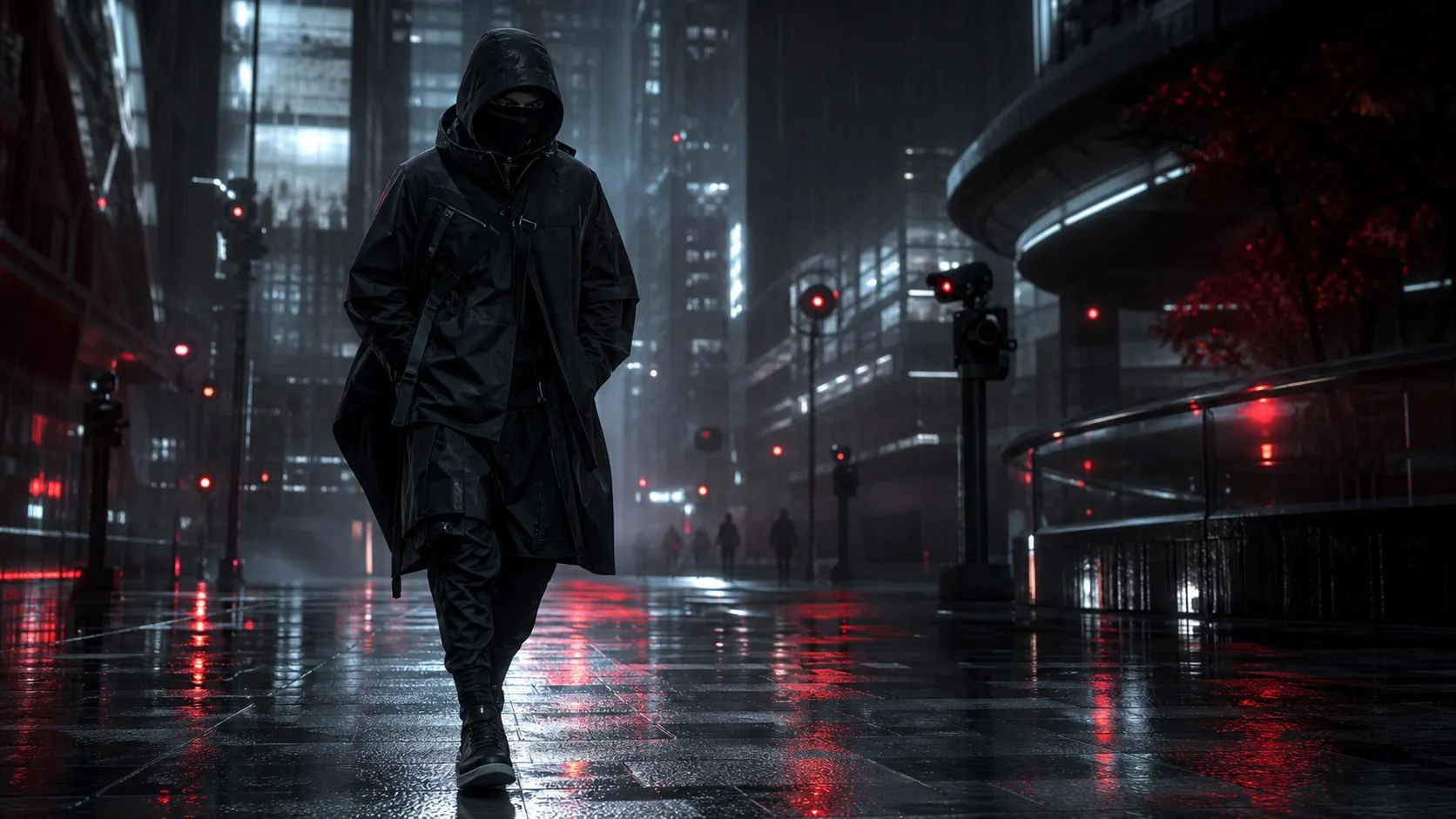
The modern city is watched by devices that are often invisible in daily life: traffic cameras, retail analytics, doorbell networks, office access systems, phones, drones and platform algorithms. Clothing has always adapted to the city. Now it must adapt to a city that also computes.
The new urban uniform is not a literal uniform. It is a set of design behaviors: darker surfaces, modular layers, technical pockets, weather resistance, low branding and garments that move cleanly between private life, work, transit and public space.
Surveillance as atmosphere
Surveillance is not only a camera on a pole. It is an atmosphere of measurement. The city increasingly observes flows: who enters, who leaves, how long people stay, which objects they carry, how bodies move through retail, work and transport environments. Most of this is presented as convenience or safety, but it also changes the feeling of public life.
Fashion responds to atmospheres before it responds to laws. When a city feels exposed, clothing becomes protective. When commutes are unstable, clothing becomes modular. When identity is constantly photographed, branding becomes quieter and silhouette becomes more intentional.
The uniform after officewear
Traditional officewear assumed stable institutions: the office, the commute, the meeting, the restaurant. Contemporary life blends these contexts. A single jacket may need to handle rain, airport security, a studio visit, a late dinner and a camera-filled lobby. This is why techwear has become more than a niche aesthetic. It is a practical grammar for unstable environments.
The new uniform is not about looking tactical. It is about reducing friction. Matte textiles, secure closures, structured hoods, concealed storage and precise patterning help the wearer move through the city without excess visual noise.
Material choices become cultural choices
Materials communicate values. Gloss can feel performative. Matte surfaces feel controlled. Heavy branding can feel exposed. Quiet technical construction can feel self-contained. In a surveillance-aware environment, restraint becomes a luxury signal because it refuses unnecessary visibility.
This does not mean hiding. It means choosing how to appear. The strongest contemporary garments do not erase the wearer; they frame the wearer with intention.
The DUZ design response
DUZ builds the urban uniform around engineered evolution: garments that remain elegant while carrying technical logic. The Observer system uses serialized drops, monochrome architecture and subtle red signal accents to acknowledge the city as a field of perception.
- Low-profile identity: branding supports the silhouette instead of dominating it.
- Weather intelligence: shells and layers protect against climate without sacrificing drape.
- Modular utility: storage and access points are integrated into the garment architecture.
- Visual discipline: black, carbon and graphite reduce noise while red marks signal precision.
How to read these systems without panic
A useful way to think about AI visibility is to separate three layers: capture, interpretation and consequence. Capture is the sensor layer: cameras, phones, scanners and networked devices. Interpretation is the model layer: software that detects objects, estimates categories or compares patterns. Consequence is the institutional layer: what a company, platform, landlord, retailer or government does with the interpretation.
Most public conversations collapse these layers into one vague idea of surveillance. Good design should do the opposite. It should make the layers easier to understand. A garment cannot control every sensor in the city, but a brand can be honest about its own digital systems, avoid unnecessary data collection and build products that encourage customers to think critically about visibility.
Why this belongs to luxury rather than novelty
Luxury is often misunderstood as decoration or price. At its best, luxury is disciplined decision-making: better materials, fewer compromises, longer life, clearer provenance and deeper meaning. AI-era fashion needs that discipline because the subject is too serious for gimmicks. If a brand uses the language of surveillance, recognition or adversarial design, it must avoid theatrical claims and focus on durable value.
For DUZ, the value is a combination of material intelligence and cultural intelligence. A product should feel good, last long, photograph well, move naturally and carry a point of view. The article topics on this blog are not separate from the clothing; they are the research layer behind the objects.
What customers should expect from AI-aware fashion
Customers should expect clarity. If a product uses NFC, the brand should explain what the chip does. If a collection references machine vision, the brand should explain whether it is symbolic, aesthetic or functional. If a garment is limited, the serial system should support authenticity and resale without invasive tracking. If a brand speaks about surveillance, it should respect safety and not turn fear into a sales tactic.
This is the standard DUZ is building toward: technical clothing with transparent language, precise construction and a strong ethical boundary. The point is not to escape the future. The point is to enter it with better objects and better questions.
Conclusion
Surveillance changes fashion because it changes public space. The new urban uniform is not a surrender to monitoring; it is a design response to complexity. It gives the wearer control over movement, presentation and preparedness in a city that constantly records signals.