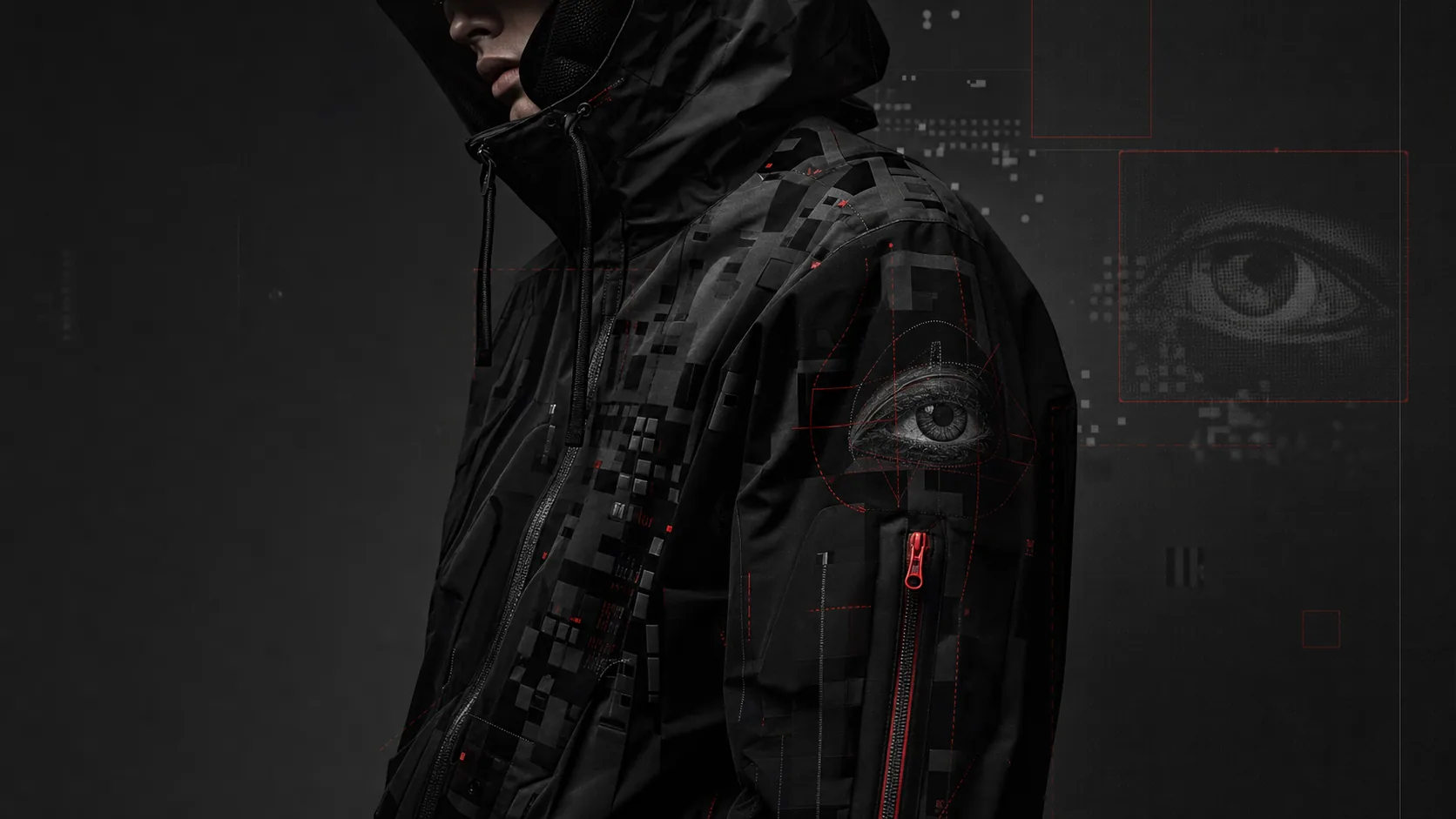
Adversarial patterns entered the public imagination as a dramatic idea: a surface that confuses a machine. For DUZ, the more interesting question is not how to trick a camera. It is what happens to fashion when clothing is interpreted by both people and algorithms at the same time.
This article examines adversarial patterns as a design, cultural and ethical subject. It does not provide instructions for evading recognition systems. Instead, it explains why machine vision matters, how visual systems read surfaces, and how a luxury techwear brand can respond responsibly.
What is an adversarial pattern?
In machine learning, an adversarial example is an input that causes a model to make a mistake. In image systems, this can involve small changes to pixels, textures, color relationships or repeated shapes that alter the confidence of a classifier. In fashion, the concept is often translated into printed garments, face-adjacent graphics or high-contrast surface systems.
The popular version of the idea is usually oversimplified. Real-world recognition systems differ by camera, lighting, model architecture, distance, motion, compression and the purpose of the system. A print that affects one demonstration model may do nothing in a different city, store, phone or database. That uncertainty is why DUZ treats adversarial aesthetics as a cultural language rather than a functional guarantee.
Why the idea still matters
Even when adversarial patterns are unreliable as tools, they are powerful as signals. They make visible a fact that is usually hidden: software is now a reader of clothing. A jacket is no longer only judged by proportion, quality and taste; it may also be segmented, classified, stored and correlated by computational systems.
That changes the symbolic meaning of garments. A geometric pattern can become a question about consent. A matte surface can suggest resistance to visual noise. A serialized product can create authenticity without demanding unnecessary personal data. The garment becomes an interface between the body, the city and the machine.
From camouflage to literacy
Traditional camouflage was designed around the eye of a human observer. Machine-era camouflage is more complex because the observer is a network: camera sensors, edge models, cloud systems, retail analytics, phone software and social media compression. The goal for responsible fashion should not be to sell fantasies of invisibility. It should be to increase literacy about how visibility works.
DUZ uses the Observer language in this direction. The geometric eye is not a promise that the wearer disappears. It is a reminder that perception itself has become designed infrastructure.
Design principles for responsible adversarial aesthetics
- Never overclaim protection. A garment should not promise to defeat surveillance or recognition systems.
- Use pattern as critique. Geometry can communicate awareness without becoming operational evasion.
- Prioritize material quality. The garment must succeed as clothing first: cut, comfort, durability, silhouette and craft.
- Respect public safety. Design should not encourage harmful misuse or unsafe behavior.
- Explain the context. Customers deserve honest language about what the design means and what it does not do.
The DUZ interpretation
The Observer Hoodie and future Observer pieces use black systems, restrained geometry and serialized identity to build a language of engineered perception. The pattern is a philosophical layer, not a technical exploit. It belongs to the same world as NFC provenance, modular construction and matte material architecture.
The future of AI-aware fashion will not be defined by gimmicks. It will be defined by brands that can make machine-era visibility understandable, beautiful and honest.
How to read these systems without panic
A useful way to think about AI visibility is to separate three layers: capture, interpretation and consequence. Capture is the sensor layer: cameras, phones, scanners and networked devices. Interpretation is the model layer: software that detects objects, estimates categories or compares patterns. Consequence is the institutional layer: what a company, platform, landlord, retailer or government does with the interpretation.
Most public conversations collapse these layers into one vague idea of surveillance. Good design should do the opposite. It should make the layers easier to understand. A garment cannot control every sensor in the city, but a brand can be honest about its own digital systems, avoid unnecessary data collection and build products that encourage customers to think critically about visibility.
Why this belongs to luxury rather than novelty
Luxury is often misunderstood as decoration or price. At its best, luxury is disciplined decision-making: better materials, fewer compromises, longer life, clearer provenance and deeper meaning. AI-era fashion needs that discipline because the subject is too serious for gimmicks. If a brand uses the language of surveillance, recognition or adversarial design, it must avoid theatrical claims and focus on durable value.
For DUZ, the value is a combination of material intelligence and cultural intelligence. A product should feel good, last long, photograph well, move naturally and carry a point of view. The article topics on this blog are not separate from the clothing; they are the research layer behind the objects.
What customers should expect from AI-aware fashion
Customers should expect clarity. If a product uses NFC, the brand should explain what the chip does. If a collection references machine vision, the brand should explain whether it is symbolic, aesthetic or functional. If a garment is limited, the serial system should support authenticity and resale without invasive tracking. If a brand speaks about surveillance, it should respect safety and not turn fear into a sales tactic.
This is the standard DUZ is building toward: technical clothing with transparent language, precise construction and a strong ethical boundary. The point is not to escape the future. The point is to enter it with better objects and better questions.
Conclusion
Adversarial patterns are important because they reveal that clothing now participates in a computational environment. The responsible response is not fear, nor false invisibility. It is design with literacy: garments that acknowledge machine vision while preserving human dignity, quality and agency.